

MACHINE LEARNING
Made in 2022, Machine Learning uses my photographs of industrial and rural landscapes as prompts for early generative AI, asking how machine-made variations shift the way we see and understand authorship.

A tall, weathered concrete building with a window and a small opening, surrounded by leafless trees and dry grassy field under a clear blue sky.

An exterior scene of a house with a large tree in front and a grassy yard, under a clear blue sky.

A large, dark grey concrete building with small, vertical windows. Surrounding trees with leafless branches and grass with patches of green and brown.

An old brick chimney or tower with small square openings, standing outdoors in a rural area with green grass and leafless trees under a clear blue sky.

"Original"


1950 edition. Cover image: Open Library.
REFERENCE POINT #1 — NORBERT WIENER
“Feedback is a method of controlling a system by reinserting into it the results of its past performance. If these results are merely used as numerical data for the criticism of the system and its regulation, we have the simple feedback of the control engineers. If, however, the information which proceeds backward from the performance is able to change the general method and pattern of performance, we have a process which may well be called learning.”
Norbert Wiener, The Human Use of Human Beings: Cybernetics and Society (1950).



Book cover: Reaktion Books, 2000 edition.
REFERENCE POINT #2 — VILÉM FLUSSER
Flusser’s account of photography asks how the apparatus shapes what a photographer can make. In Machine Learning (2022), an experiment with early generative AI, the photograph becomes a prompt for another image-making system. The question of authorship extends from choosing what to photograph to negotiating the possibilities of a model.
Explore Towards a Philosophy of Photography — Reaktion Books


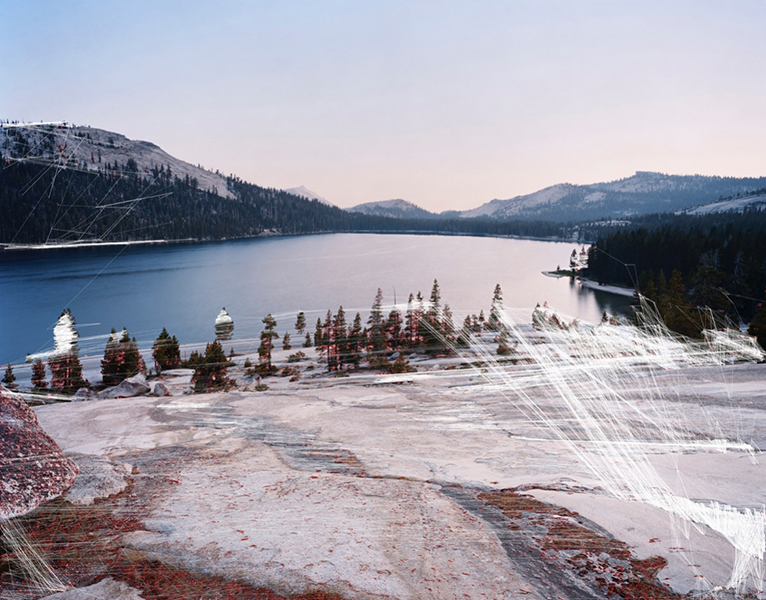
Maximally Stable External Regions; Hough Transform.
Image reproduced in The New Inquiry.
REFERENCE POINT #3 — TREVOR PAGLEN
Paglen’s Invisible Images examines images processed by machines and the systems that shape their interpretation. His Lake Tenaya makes that difference visible within a landscape. Alongside Machine Learning, it opens a question: what happens when a photographed place becomes material for computational interpretation and the production of new images?
Read “Invisible Images (Your Pictures Are Looking at You)” — The New Inquiry, 2016


